Teen/Young Adult Pedcasts

Dr. M’s SPA Newsletter Volume 16 Issue 2 – School Food

School Based Nutrition – Why is it happening this way?

There is a quiet experiment happening in American childhood, and we should stop pretending it’s benign.

In the 1970s and 1980s, when I attended school, school food was far from perfect, but it existed in the context of something essential: it was mostly prepared on site, minimally processed (but changing in that direction) and not laden with additives and chemicals (Yet). Oh, and most children still ate meals prepared at home at almost every other occasion. Dinner wasn’t aspirational or Instagram-worthy, but it was routine. Real food. Cooked by someone who knew the child, at a table where nervous systems could downshift. School lunch was a supplement to that structure, not the metabolic foundation of a child’s life. That has all changed in a short 50 years. Mirroring the change in weight and childhood disease prevalence.

• 1970s – some processed foods begin to enter school cafeterias at scale
• 1980s – preservatives and additives become routine
• 1990s – ultra-processed foods dominate

In 1994, new standards were added: This table lays out how much of each food group schools were supposed to offer over a week under the 1994 standards. These were the first nutrition-focused meal standards the USDA put into place:

For Breakfast (all grades K–12):
Fruit: 2.5 cups/week
Vegetables: 0 cups/week
Grains/Bread: 0–10 oz equivalent/week (depending on combinations of grains and protein)
Meat/Meat-alternative: 0–10 oz equivalent/week
Milk: 5 cups/week

For Lunch (split by grade levels):
Fruit: K–3 also 2.5 cups; grades 4–12 get 3.75 cups/week
Vegetables: still 0 cups/week (no separate vegetable requirement yet)
Grains/Bread: at least 8 oz eq/week
Meat/Meat-alternative: 7.5 oz eq/week for breakfast; 10 oz eq/week for lunch
Milk: 5 cups/week

(Hopkins 2015)

What’s notable, reflected in the structure of this table, is that vegetables weren’t required at all yet, and the standards were very much food-group based, not ingredient-level nutrient quality checks. That created space for schools to rely on industrially produced entrées and sides that technically met volumes of grains or proteins but could still be ultra-processed products with long ingredient lists, many of these foods would meet a NOVA class 4 classification (the worst type). Think fruit cup in sugary syrup…..

Dr. M

Dr. M’s SPA Newsletter Volume 16 Issue 1 – Beyond Behaviors Part 3, Mona Delahooke, PhD

Screenshot

Chapter 3 – Individual Differences

Dr. Delahooke starts Chapter 3 by allowing Margaret Mead to remind us that each child is absolutely unique: “Always remember that you are absolutely unique. Just like everyone else.” This is more than a witty paradox, it is the hinge upon which all effective pediatric care swings. When we take individual differences seriously as neurobiological fact, we can finally stop confusing adaptive survival responses with defiance, stop labeling children as problems, and begin the real work of supporting the mind body systems that shape behavior from the inside out.

Let us review what we have learned in Beyond Behaviors so far – We are invited to descend below the waterline of the behavioral iceberg. What we see at the surface: the tantrum, withdrawal, rigidity, hyperactivity, the refusal to transition is merely a set of observable outputs from deeply personal internal variables. The sensory wiring, physiological states, immune triggers, thoughts, feelings, memories, and the child’s moment-to-moment sense of safety. Without diving into these subterranean layers, we risk treating smoke while ignoring the fire, which is the general state of current pediatric psychiatric medical therapeutics. We mostly treat the smoke. We don’t often ask about the fire. Her central thesis is simple, clinically robust, and profoundly humane:

Children behave according to the state of their nervous system, and their nervous system is shaped by individual biological, emotional, and sensory differences.

Once we understand this, behavior becomes not a moral test but a window into the child’s internal world…..

Dr. M

Dr. M’s Women and Children First Podcast #100 Wayne Koontz, MD – Vaccines and Disease over 50 years

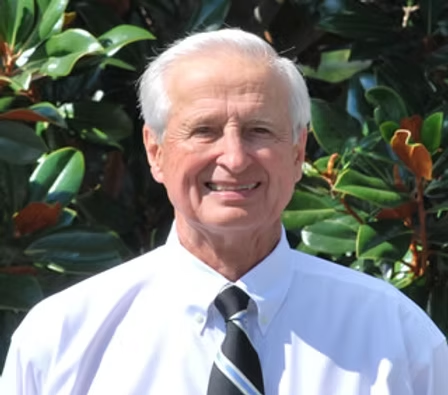
Today on Dr. M’s Women and Children First Podcast, we welcome Dr. Wayne Koontz, a founding partner at Salisbury Pediatric Associates in Salisbury North Carolina, where he has spent over 5 decades caring for generations of families with compassion, wisdom, and a deep commitment to community health.

Dr. Koontz earned his Undergraduate degree and his Doctor of Medicine from Wake Forest University, where his early love of science and service began to take shape. He went on to complete his pediatric residency at Dallas Children’s Medical Center, part of the University of Texas Southwestern Medical School, where he received outstanding training in both academic and clinical pediatrics.

As one of the founding physicians at Salisbury Pediatrics, Dr. Koontz helped to build a model of child-centered, family-oriented care that has served the Rowan County. His commitment to children’s well-being extends beyond the clinic, reflecting a lifelong dedication to preventive medicine, developmental health, and the nurturing of strong physician–family relationships.

It’s an honor to have Dr. Koontz with us today to share his clinical insights as they relate to infection and vaccination from a longevity based pediatric career. Dr. Koontz has a unique perspective to share as his 50 plus years of experience cover the prevaccine infectious disease based practice of pediatric medicine all the way to the current vaccine centric and reduced infectious disease burden reality. That is a timeline worthy of exploration.

So lets explore.

Dr. M

Dr. M’s Women and Children First Podcast #99 Liz Mumper, MD – Kids and Covid

Welcome to Dr. M’s Women & Children First Podcast, where we engage with pioneering voices at the intersection of science, healthcare, and the well-being of families.

Today on Dr. M’s Women and Children First, we welcome Dr. Elizabeth Mumper, a physician, educator, and thought leader whose career has profoundly influenced the practice of integrative pediatrics.

Dr. Mumper earned her Bachelor of Science degree from Bridgewater College, graduating magna cum laude, before attending the Virginia Commonwealth University School of Medicine, where she received her medical degree. She completed her pediatric residency at the University of Virginia and served as Chief Resident in Pediatrics. She remained at UVA as an Associate Professor of Clinical Pediatrics from 1997 to 2005, mentoring future physicians and advancing holistic, evidence-based approaches to child health.

Following her time in academia, Dr. Mumper founded The Rimland Center for Integrative Medicine in Lynchburg, Virginia, a clinic dedicated to children with autism spectrum disorders, PANS/PANDAS, allergies, and complex chronic illnesses. Her practice integrates the best of conventional pediatrics with biomedical and functional medicine principles, always guided by compassion and curiosity.

She has been a leading educator with the Medical Academy of Pediatric Special Needs (MAPS) and a frequent international lecturer, teaching clinicians how to recognize and treat the root causes of immune dysregulation, inflammation, and neurodevelopmental challenges.

Dr. Mumper is also the author of the new book Kids and COVID, an insightful exploration of how the pandemic impacted children, physically, emotionally, and developmentally, and what lessons medicine must learn moving forward. In our conversation, we discuss her book in depth, as well as the broader implications of the COVID-19 pandemic for pediatric care, resilience, and future public health policy.

Finally, we dive into the complex topic of vaccines, considering what we’ve learned from the pandemic years and expanding the conversation begun with Dr. Paul Offit and Dr. Joel Warsh.

Dr. Mumper’s lifelong dedication to children, her fearless pursuit of truth, and her balanced, science-driven voice make her one of the most respected figures in functional medicine.

Please join me in welcoming my friend and colleague,  Dr. Elizabeth Mumper.

Dr. M

Dr. M’s Women and Children First Podcast #96 Joel Warsh, MD Vaccines – What Do We Know in 2025?

Welcome back to Dr. M’s Women and Children First podcast where we look at the world of Women and Children’s Health through an anthropological lens with the humble understanding that we have a lot to learn.

Today, I’m joined by Dr. Joel “Dr. Gator” Warsh, a pediatrician, author, and advocate for a whole-child approach to healthcare. Dr. Warsh earned his medical degree from Thomas Jefferson Medical College and completed his pediatric residency at Children’s Hospital of Los Angeles. Along the way, he also obtained a Master’s degree in Epidemiology and Biostatistics from Queen’s University in Canada, giving him a strong foundation in both clinical care and population health. These educational pursuits make him uniquely suited for today’s conversation on vaccines.

He is the author of Between a Shot and a Hard Place. In his own words, he says: I’ve dedicated my career to helping families navigate complicated health topics with clarity. My book addresses vaccine questions in a calm, data-driven, and practical way, offering parents guidance that steers clear of extremes. Parents face unprecedented pressure to make the “right” choices, often without enough balanced information. He has been featured on major platforms sharing his message with more than 400,000 parents through social media. We discuss his passion for empowering families to make informed, individualized decisions, including in areas that have been challenging or even taboo to discuss.

Today, we’ll dive into his latest work, his perspectives on vaccines and preventative care, and how he envisions a future of pediatrics that is proactive rather than reactive. This is a conversation about rethinking the foundations of child health and it’s one you won’t want to miss.

Enjoy,

Dr. M

Dr. M’s Women and Children First Podcast #93 – Lisa Danahy, MS, C-IAYT, YACEP – Calming the Next Generation

Today’s guest is Lisa Danahy, a powerhouse in the world of yoga therapy, trauma-informed education, and social-emotional learning. With over three decades of experience as a school administrator, curriculum designer, and wellness educator, Lisa brings a rare blend of clinical insight, compassion, and practical tools to help children and the adults who care for them find calm in a chaotic world.

Lisa holds a Master of Science in Yoga Therapy, is a certified yoga therapist and educator, and is the founder of Create Calm, a nationally recognized nonprofit that’s transformed wellness access for neurodiverse, disabled, and underserved youth across the country. Since 2016, Create Calm has delivered evidence-based programs to thousands of students, educators, and families in school systems nationwide.

Lisa’s approach integrates the latest research in psychology, neuroscience, and movement science into accessible practices that support emotional regulation, resilience, and whole-person healing. She’s a Hay House author, international speaker, and a trusted trainer for clinicians, caregivers, and teachers alike.

Stay with us as we explore how her work is redefining wellness in schools, clinics, and communities.

You can learn more about Lisa’s work at www.CreateCalm.org and www.MondayMindfulness.com.

Let’s dive in.

Please Enjoy,

Dr. M

Dr. M’s Women and Children First Podcast #92 – Kristin Jones, OT – A Therapists View of the World Today

\

Welcome back to Dr. M’s Women and Children First podcast where we look at the world of Women and Children’s Health through an anthropological lens with the humble understanding that we have a lot to learn.

Today, we’re honored to welcome Kristin Jones, a seasoned occupational therapist from Mooresville, North Carolina, whose career reflects both deep compassion and bold innovation in the service of neurodivergent children. Kristin brings 24 years of clinical and educational experience, including the past 14 spent working in a K-12 public charter school. Recently, she shifted gears in the most personal of ways—taking time away from school-based therapy to homeschool her daughter, who has Down Syndrome.

Kristin earned her Master of Occupational Therapy from Misericordia University in 2000 and has spent her career supporting children and families across a broad spectrum of settings from early intervention and outpatient sensory clinics to schools and feeding therapy. Her passion lies in translating complex concepts from brain development and the Autistic lived experience into practical, accessible strategies for educators.

In addition to her clinical work, Kristin is committed to the education of future therapists. She serves as adjunct faculty at Misericordia University and teaches with Education Resources Inc. Her presentations with the Therapist Neurodiversity Collective reflect her ongoing mission to uplift neurodivergent voices and move beyond outdated therapeutic norms.

Kristin’s voice is one of clarity and respect for children, for families, and for the evolving science of how we learn, communicate, and thrive.

Let’s dive in,

Dr. M

1 2 52