
Dr. M’s Women and Children First Podcast #95 – Sanjay Bhorjaj, MD – Living Longer and Klotho

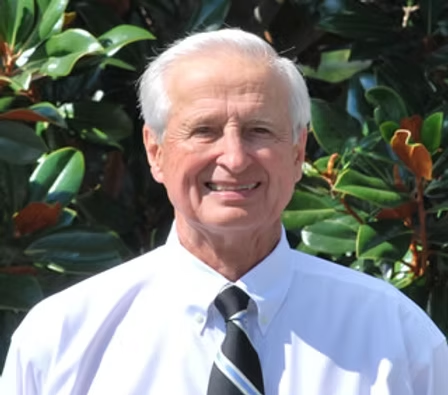
Today’s guest is Dr. Sanjay Bhojraj, a powerful voice at the crossroads of advanced interventional cardiology and root-cause wellness. Dr. Bhojraj is board-certified in Cardiovascular Diseases and Interventional Cardiology, and one of only a small number of interventional cardiologists in the United States who is also certified in Functional Medicine through the Institute for Functional Medicine.

Dr. Bhojraj earned his medical degree from Indiana University School of Medicine, trained in internal medicine at Northwestern, and completed a cardiology fellowship at the renowned Henry Ford Health System. For over two decades, he practiced in conventional cardiology, saving lives daily with stents, angioplasties, and transcatheter valve replacements.

But along the way, something essential began to stir. He found himself asking bigger questions: Why do people arrive in the cath lab in the first place? Why are we not doing more to prevent the first or second heart event? And what role do nutrition, sleep, stress, and emotional health truly play in long-term cardiovascular outcomes?

These questions led Dr. Bhojraj to Functional Medicine, not as an alternative, but as an evolution, a model that restores agency to patients and equips the body to heal through comprehensive lifestyle optimization. He now leads the Well12 Program, a transformational experience that guides individuals in upgrading the foundational systems of their health from metabolism to mindset, so they can live not just longer, but better.

Today, Dr. Bhojraj and I explore the remarkable protein Klotho and the emerging science linking it to human longevity and health span. This is a conversation you won’t want to miss, a glimpse into what may become a defining frontier in upstream disease prevention.

Enjoy,

Dr. M

Dr. M’s SPA Newsletter Volume 15 Issue 15

Systemic Maternal Inflammation and Neurodevelopment: The Role of IL-6 and IFN-γ in Autism Spectrum Disorder

I just returned from Estes Park, Colorado where I presented a lecture on the Growing Brain/Mind – a tour through the underpinnings of childhood neurological changes that we call Autism. The timing is perfect for this article to be written.

In an era when chronic disease in children is rising at an unprecedented pace, the search for root causes must include an honest inquiry into the conditions present during fetal development. The review article by Majerczyk and colleagues, Systemic Maternal Inflammation Promotes ASD via IL-6 and IFN-γ, brings forward a critical piece in this puzzle that I began to explore a few years ago when writing a book. It connects the dots between maternal immune dysregulation and long-term neurodevelopmental outcomes, specifically autism spectrum disorder (ASD). Through a synthesis of clinical data and animal research, the authors make a compelling case for the centrality of two inflammatory messengers, interleukin-6 (IL-6) and interferon-gamma (IFN-γ), in shaping fetal brain development during gestational stress. The key words here being GESTATIONAL STRESS, the recurring scientific theme for ASD development, not vaccines… and some literature reviews.

Dr. M

Dr. M’s Women and Children First Podcast #94 – Melinda Elliott, MD – Feeding the Infants

Today, we explore the intersections of cutting-edge science, compassionate care, and the future of pediatric and maternal health with Dr. Melinda Elliott, MD, FAAP, a leading neonatologist and the Chief Medical Officer at Prolacta Bioscience. Dr. Elliott has dedicated her career to advancing the care of our most vulnerable patients, premature and medically fragile infants, through both clinical excellence and research-driven innovation.

Dr. Elliott earned her medical degree from West Virginia University School of Medicine. She went on to complete her residency in pediatrics and her fellowship in neonatal-perinatal medicine at the University of Florida, where she also served as chief resident and a faculty member, helping to train the next generation of pediatricians and neonatologists.

Throughout her clinical and leadership career, Dr. Elliott has been deeply involved in advancing evidence-based care in the NICU, improving nutritional strategies for preterm infants, and advocating for human milk as a therapeutic intervention in neonatal health. Her work with Prolacta Bioscience supports NICUs around the globe in providing 100% human milk–based nutrition to reduce complications such as necrotizing enterocolitis (NEC), a devastating condition that disproportionately affects preterm infants.

Please join me in welcoming Dr. Melinda Elliott, a champion for babies and a voice for innovation in neonatal medicine.

Dr. M

Dr. M’s SPA Newsletter Volume 15 Issue 14

As I have told many of my patients, I would write immediately when NC sees its first Measles case.

Well, North Carolina has its first measles case: The North Carolina Department of Health and Human Services has confirmed a case of measles in a child who was visiting Forsyth and Guilford counties. The child became ill while traveling to NC from another country where measles outbreaks have recently been reported. To protect the individual and their family’s privacy, no additional information about this individual will be released. This is the first confirmed case of measles in the state in 2025. NCDHHS is recommending all unvaccinated individuals ages one year and older receive measles vaccination to protect themselves and those around them. (NCDHHS)

So, it is finally in NC. If you are still on the fence of whether to vaccinate, the issue is now truly pressing.

From the CDC:

U.S. Hospitalizations in 2025

12% of cases hospitalized (148 of 1227)

Percent of Age Group Hospitalized

Under 5 years: 20% (72 of 355 cases) 50% of the total hospitalized. Highest risk bucket.

5-19 years: 8% (35 of 455)

20+ years: 10% (40 of 404)

Age unknown: 8% (1 of 13)

Deaths 3

And a story on Insurance Hell.

Enjoy,
Dr. M

Dr. M’s SPA Newsletter Volume 15 Issue 13

Literature Review

1) An exciting phase three trial with the CETP inhibitor Obicetrapib has shown serious promise for ASCVD and Alzheimer’s Disease (AD). “In BROADWAY, a pre-specified AD sub-study was designed to assess plasma AD biomarkers in patients enrolled in the BROADWAY trial and evaluated the effects of longer duration of therapy (12 months) with a prespecified population of ApoE3/4 or 4/4 carriers. The sub-study included 1727 patients, including 367 ApoE4 carriers. The primary outcome measure was p-tau217 absolute and percent change over 12 months. Additional outcome measures included neurofilament light chain (“NFL”), glial fibrillary acidic protein (“GFAP”), p-tau181, and Aβ42/40 ratio absolute and percent change over 12 months. NewAmsterdam observed statistically significant lower absolute changes in p-tau217 compared to placebo over 12 months in both the full ITT population (p<0.002) and in ApoE4 carriers (p=0.0215).” (NAMS)

Obicetrapib has shown significant LDL and Lp(a) lowering effects as well in early trials. I will be watching this discovery closely as it may be a game changer for these diseases. “In the BROADWAY trial, more than 2,500 participants with established heart disease or genetic high cholesterol were given either Obicetrapib or a placebo, in addition to their regular cholesterol medications. After 12 weeks, those on Obicetrapib had dropped their LDL cholesterol by 32.6 per cent and Lp(a) by 33.5 per cent on average – many achieved guideline-recommended targets for the first time.” (Sci Tech Daily) The drop in Lp(a) is the profound result as this is a massive risk factor for ASCVD and to date is not moveable by statins and most used meds.

2) GLP1 drugs and risk for macular degeneration?… and more

Dr. M

Dr. M’s Women and Children First Podcast #93 – Lisa Danahy, MS, C-IAYT, YACEP – Calming the Next Generation

Today’s guest is Lisa Danahy, a powerhouse in the world of yoga therapy, trauma-informed education, and social-emotional learning. With over three decades of experience as a school administrator, curriculum designer, and wellness educator, Lisa brings a rare blend of clinical insight, compassion, and practical tools to help children and the adults who care for them find calm in a chaotic world.

Lisa holds a Master of Science in Yoga Therapy, is a certified yoga therapist and educator, and is the founder of Create Calm, a nationally recognized nonprofit that’s transformed wellness access for neurodiverse, disabled, and underserved youth across the country. Since 2016, Create Calm has delivered evidence-based programs to thousands of students, educators, and families in school systems nationwide.

Lisa’s approach integrates the latest research in psychology, neuroscience, and movement science into accessible practices that support emotional regulation, resilience, and whole-person healing. She’s a Hay House author, international speaker, and a trusted trainer for clinicians, caregivers, and teachers alike.

Stay with us as we explore how her work is redefining wellness in schools, clinics, and communities.

You can learn more about Lisa’s work at www.CreateCalm.org and www.MondayMindfulness.com.

Let’s dive in.

Please Enjoy,

Dr. M

Dr. M’s SPA Newsletter Volume 15 Issue 12

There is a quiet truth written in the tomes of family life that science keeps confirming over and over. It’s worth pausing to reflect on.

A warm bond between a father and child lights a path toward a steady, grounded adulthood. Studies show kids with an emotionally present dad, someone who’s there with a hug or a knowing nod, are less likely to stumble into behavioral trouble. Boys, especially, often look to their fathers as a mirror, shaping themselves in the image of a dad they feel close to. It’s a simple gift: presence breeds strength, presence breeds exploration of self, presence breeds knowing, presence breeds growth in all things for men.

Now, here’s a twist you might not expect. The old-school image of the rugged, masculine dad, stoic and commanding, was once thought to mold boys into the same mold. But research, like a wise teacher, reveals otherwise. A boy’s masculinity isn’t forged by a father’s stern hand; it’s an innate spark, flickering or bold regardless of style. As a Stoic father might counsel, we can’t control the nature we’re given, only how we nurture it. So, let’s release the pressure to force a mold and instead guide with patience. This theory follows the excellence of The Carpenter and the Gardener by Gopnik…. and a recipe.

Enjoy

Dr. M