Recommendations

Dr. M’s SPA Newsletter Volume 16 Issue 30 – Safety Through Two Different Lenses

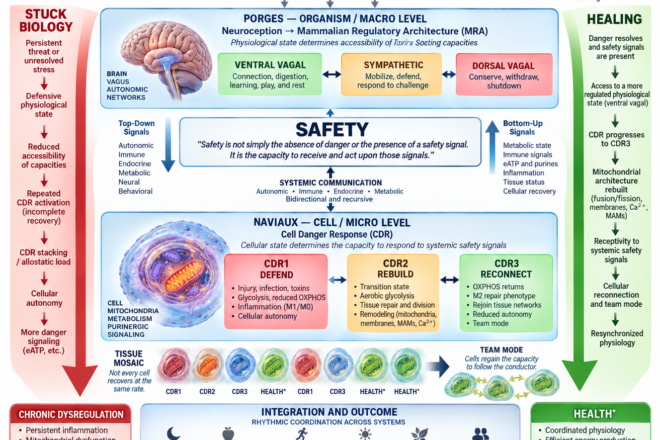
When the Body Cannot Hear That It Is Safe

What if one of the most important questions your body asks every day is also one of the simplest?

Am I safe?

We usually think of safety as an emotional idea.

Is my family safe?

Is my child safe at school?

Do I feel safe in my home?

But safety is also biology.

Your brain asks whether you are safe.

Your nervous system asks whether you are safe.

Your immune system asks whether you are safe.

And, remarkably, every cell in your body appears to ask some version of the same question.

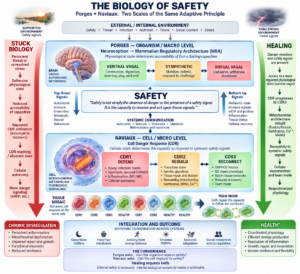
Two scientists have spent much of their careers looking at this problem from very different directions.

Dr. Stephen Porges studies the nervous system and developed Polyvagal Theory.

Dr. Robert Naviaux studies mitochondria—the tiny structures inside our cells that help manage energy—and developed the concept of the Cell Danger Response.

One studies the whole person.

The other studies the cell.

Yet their ideas meet in a fascinating place:

How does the body know when danger has passed?

And what happens when it doesn’t?

Your Nervous System Is Always Listening

Imagine walking through the woods and suddenly hearing something moving behind you.

Before you have time to think, your body changes.

Your heart beats faster. Your muscles tighten. Your attention sharpens. Digestion becomes less important.

Your body prepares you to move.

This is not a mistake.

It is exactly what your body is supposed to do.

Porges describes a nervous system that is constantly gathering information about the world around us and the world inside us.

Much of this happens without conscious thought.

He calls this process neuroception.

The nervous system is continually asking:

Is this person safe?

Is this environment safe?

Is something wrong inside my body?……..

Dr. M’s SPA Newsletter Volume 16 Issue 25 – Sivers and Literature Leading Life

“Last week someone asked why I prefer books. My immediate answer was that I love their quiet, non-commercial nature. No ads. No hype. Just quiet wisdom with deep rewards for a focused mind.

But today I realized something more profound: Each of my biggest life-changing moments came from a single sentence deep inside a book.” (Sivers D. 2026)

I still prefer to hold a book in my hands, the weight of it, the rough-hewn pages beneath my fingers, the quiet ritual of turning one page after another.

Reading, for me, has never been simply about absorbing information. It is the privilege of living for a while through another person’s eyes. We borrow their world, their memories, their fears and joys, and somehow return to our own lives seeing them a little differently.

And then there are the words themselves. Sometimes I stop not because of what happened in the story, but because of the way someone chose to say it. A sentence can be so beautiful that it deserves to be read twice.

Perhaps that is what I love most about books.

For a little while, the world gets quiet, someone else begins to speak, and I get to simply be in love with words.

For me, the changes are not as profound as Derek noted in his response. (hit the link below to read his life altering passages) For me, most passages were more in line with philosophy and health.

and more….

Dr. M

Dr. M’s Women and Children First Podcast #112: Mona Delahooke, PhD – Beyond Behaviors


Today on Dr. M’s Women and Children First, we welcome one of the most important voices in modern child development and behavioral science, Mona Delahooke.

Dr. Delahooke is a licensed clinical psychologist, internationally recognized speaker, and the author of groundbreaking books including Beyond Behaviors and Brain-Body Parenting. Her work challenges one of the deepest assumptions in modern parenting and education: that difficult behaviors are simply choices to be corrected. Instead, she invites us to ask a radically different question, what is the nervous system trying to communicate?

This conversation sits right at the crossroads of neuroscience, attachment theory, polyvagal theory, developmental psychology, and the lived experience of parenting. In many ways, Mona’s work gives language to something clinicians and parents often feel intuitively but struggle to articulate: behavior is not merely compliance or defiance, behavior is biology expressed through the body.

We explore how stress physiology, early attachment, sensory processing, trauma, neurodivergence, and autonomic nervous system states shape the way children interact with the world around them. We discuss why punishment-based models often fail vulnerable children, how “bad behavior” may actually represent adaptive survival responses, and why safety and connection are foundational to learning, resilience, and emotional regulation.

For me personally, this conversation resonates deeply with the broader themes we often discuss on this podcast, the interaction between environment, physiology, immune health, metabolism, and neurodevelopment. Mona helps bridge the gap between cellular stress and relational stress, between body and mind, between physiology and behavior.

If you’ve ever cared for a child with anxiety, ADHD, autism, sensory challenges, explosive behavior, school struggles, or chronic dysregulation, this episode offers both compassion and a fundamentally different framework. One that moves away from blame and toward curiosity. Away from control and toward connection.

This is a conversation about seeing children more clearly. And perhaps, seeing ourselves more clearly too.

Please enjoy this conversation with Dr. Mona Delahooke.

Dr. M

Dr. M’s Women and Children First Podcast #97 Paul Offit, MD – Vaccines – What Do We Know in 2025 Part 2?

Welcome back to Dr. M’s Women & Children First, where we explore the front lines of children’s health and what matters most for our families.

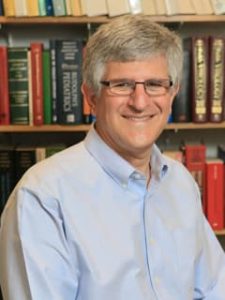
Today I’m honored to bring you Dr. Paul A. Offit, the Director of the Vaccine Education Center and Professor of Pediatrics in the Division of Infectious Diseases at Children’s Hospital of Philadelphia. He also holds the Maurice R. Hilleman Professorship of Vaccinology at the University of Pennsylvania.

Dr. Offit is a globally recognized expert in virology and immunology. He has served on the CDC’s Advisory Committee on Immunization Practices and FDA’s Vaccines and Related Biological Products Advisory Committee. He’s co-editor of the seminal vaccine textbook Vaccines, and for decades has been one of the clearest scientific voices defending evidence, transparency, and children’s health.

This week, we’ll dig into COVID, vaccine policy, and what’s ahead for children in light of the latest shifts. Among current headlines: Healthy children and pregnant women are no longer being uniformly recommended for COVID vaccines by Health Secretary Robert F. Kennedy Jr., a decision that’s stirring debate among pediatricians and public health experts like Dr. Offit. He’s sharply voiced concerns about removing key vaccine recommendations without new data, and about the broader implications of loosening vaccine guidance for the public good.

In this conversation, we’ll cover:

  • What the science says now about bivalent COVID vaccines in kids

  • How recent policy changes affect vaccine access, trust, and safety

  • What parents need to know—what’s changed, what’s stable, and what remains uncertain

This is my third time talking with Dr. Offit, and as always, I expect you’ll leave with clarity, evidence, and questions worth sharing.

I hope you enjoy this conversation.

Let’s dive in.

Dr. M

Dr. M’s SPA Newsletter Volume 15 Issue 9

Today, I’m diving into a fascinating article by Scott Zimmerman and Russel J. Reiter, titled Melatonin and the Optics of the Human Body, published in Melatonin Research (2019). This piece flips the script on what we thought we knew about melatonin, light, and how our bodies interact with the sun’s rays. It’s a game-changer, especially for how we think about kids’ health in our modern, screen-filled indoor living world.

First, what is melatonin? Melatonin is a hormone made from the essential amino acid, tryptophan. It was first isolated from a cow’s pineal gland. It is an old molecule as primitive bacteria made melatonin probably 2.5 billion years ago. Its synthesis in bacteria and eukaryotes is a common linkage. Most of us know that melatonin is the “sleep hormone,” produced by the pineal gland in the brain when it gets dark at night, signaling to our bodies that it’s time to wind down and prepare to sleep. It’s the chemical expression of darkness, driving our circadian rhythms and helping us catch those precious brain cleansing moments. Zimmerman and Reiter argue that this is only half the story or maybe even less than half. For decades, research has hyper-focused on pineal melatonin that is regulated by visible light hitting our retinas. Blue visible spectrum light in the early morning suppresses pineal melatonin, which is why we should dim those screens before bed. But here’s where it gets interesting, the pineal gland isn’t the only place melatonin is made, and darkness isn’t its only trigger. Our bodies are producing melatonin in ways we’re just starting to understand, and it’s tied to light in a way that was unexpected and evolutionarily fascinating. As with all things in science and evolution, we learn what we did not know and it all makes sense once the aha moment occurs…. and a literature review. Oh and a recipe.

Dr. M

Dr. M’s Women and Children First Podcast #Redo #2 – Ken Cook

Today, I’m thrilled to repost the conversation with Ken Cook, President and Co-Founder of the Environmental Working Group, a powerhouse built to  protect human health and the planet. For over 30 years, he’s been a leading voice challenging industrial agriculture, flawed U.S. food policies, and the toxic threats facing families—especially women and kids. From pushing the 1996 Food Quality Protection Act to shield children from pesticides to creating tools like the Skin Deep Database and Dirty Dozen list, Ken’s work empowers moms with science to make safer choices.

His latest venture is a podcast entitled Ken Cook Is Having Another Episode where he digs into endocrine disruptors and environmental health, issues hitting close to home for every parent.

I hope that you enjoy my conversation with Ken Cook!

Dr. M

Dr. M’s Women and Children First Podcast #14 Repost- Richard Johnson MD – Nature Wants Us to Be Fat

This is a repost of the most listened to podcast with Richard J. Johnson, M.D.. Dr. Johnson is the Tomas Berl Professor of Medicine and the Chief of the Renal Division and Hypertension at the University of Colorado since 2008. A graduate of the University of Wisconsin, Madison, with a major in Anthropology, and a graduate of the University of Minnesota Medical School, Minneapolis, he is a physician and nephrologist whose research has focused on the role of sugar, and especially fructose, in driving obesity, diabetes, high blood pressure and kidney disease. Much of this work has explored the role of fructose metabolism, especially the generation of uric acid, in driving this phenotype, and his work has included studies ranging from molecular biology, integrative physiology, and evolutionary biology. He is the author of The Sugar Fix which introduced the first low fructose diet, and also The Fat Switch which explores the role of fructose in driving the obesity epidemic. His newest book, Nature Wants Us To Be Fat, is a tour de force of the entire pathway of survival via metabolic events in the body related to fructose and the polyol pathway. This is a must read book. This podcast will introduce you to the exceptional work of Dr. Johnson and how we are now mismatched metabolically for the environment of modern America and our food systems.

Please enjoy this wide ranging conversation.

Dr. M

1 2 … 9