Tag Archives: polyvagal theory

Dr. M’s SPA Newsletter Volume 16 Issue 30 – Safety Through Two Different Lenses

When the Body Cannot Hear That It Is Safe

What if one of the most important questions your body asks every day is also one of the simplest?

Am I safe?

We usually think of safety as an emotional idea.

Is my family safe?

Is my child safe at school?

Do I feel safe in my home?

But safety is also biology.

Your brain asks whether you are safe.

Your nervous system asks whether you are safe.

Your immune system asks whether you are safe.

And, remarkably, every cell in your body appears to ask some version of the same question.

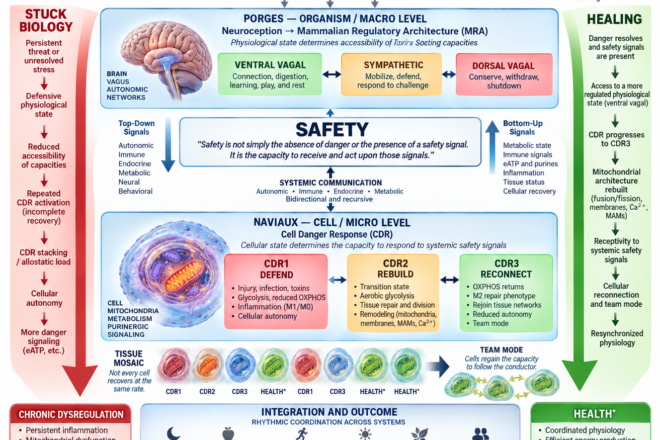
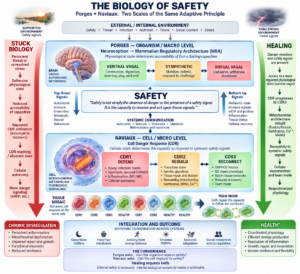
Two scientists have spent much of their careers looking at this problem from very different directions.

Dr. Stephen Porges studies the nervous system and developed Polyvagal Theory.

Dr. Robert Naviaux studies mitochondria—the tiny structures inside our cells that help manage energy—and developed the concept of the Cell Danger Response.

One studies the whole person.

The other studies the cell.

Yet their ideas meet in a fascinating place:

How does the body know when danger has passed?

And what happens when it doesn’t?

Your Nervous System Is Always Listening

Imagine walking through the woods and suddenly hearing something moving behind you.

Before you have time to think, your body changes.

Your heart beats faster. Your muscles tighten. Your attention sharpens. Digestion becomes less important.

Your body prepares you to move.

This is not a mistake.

It is exactly what your body is supposed to do.

Porges describes a nervous system that is constantly gathering information about the world around us and the world inside us.

Much of this happens without conscious thought.

He calls this process neuroception.

The nervous system is continually asking:

Is this person safe?

Is this environment safe?

Is something wrong inside my body?……..

Dr. M’s Women and Children First Podcast #113: Navaz Habib, DC – Vagal Action and Health


Welcome back to Dr. M’s Women and Children First.

Today, we are joined by one of the leading voices in the world of vagus nerve health, functional medicine, and autonomic nervous system regulation, Dr. Navaz Habib.

Dr. Habib is a chiropractor, educator, international speaker, and author of the bestselling books *Activate Your Vagus Nerve* and *Upgrade Your Vagus Nerve*. His work has helped bring the science of the vagus nerve from the research world into practical clinical medicine, helping providers and patients better understand the powerful connection between the brain, immune system, gut, metabolism, and overall health.

On today’s episode, we take a pediatric lens to this fascinating topic. We explore how vagal tone influences inflammation, stress resilience, digestion, sleep, emotional regulation, and neurodevelopment. We discuss what happens when the autonomic nervous system becomes dysregulated, how chronic stress can shape a child’s physiology, and why the vagus nerve may be one of the most important communication highways in the body.

We’ll also dive into practical strategies that families and clinicians can use to support vagal function, including breathing techniques, movement, nutrition, social connection, sleep, and other evidence-informed interventions that can help children build greater resilience in an increasingly stressful world.

If you’ve ever wondered how the nervous system intersects with immune health, behavior, gut function, and chronic disease risk, this conversation is for you.

Please join me in welcoming Dr. Navaz Habib.

Dr. M

Dr. M’s Women and Children First Podcast #112: Mona Delahooke, PhD – Beyond Behaviors


Today on Dr. M’s Women and Children First, we welcome one of the most important voices in modern child development and behavioral science, Mona Delahooke.

Dr. Delahooke is a licensed clinical psychologist, internationally recognized speaker, and the author of groundbreaking books including Beyond Behaviors and Brain-Body Parenting. Her work challenges one of the deepest assumptions in modern parenting and education: that difficult behaviors are simply choices to be corrected. Instead, she invites us to ask a radically different question, what is the nervous system trying to communicate?

This conversation sits right at the crossroads of neuroscience, attachment theory, polyvagal theory, developmental psychology, and the lived experience of parenting. In many ways, Mona’s work gives language to something clinicians and parents often feel intuitively but struggle to articulate: behavior is not merely compliance or defiance, behavior is biology expressed through the body.

We explore how stress physiology, early attachment, sensory processing, trauma, neurodivergence, and autonomic nervous system states shape the way children interact with the world around them. We discuss why punishment-based models often fail vulnerable children, how “bad behavior” may actually represent adaptive survival responses, and why safety and connection are foundational to learning, resilience, and emotional regulation.

For me personally, this conversation resonates deeply with the broader themes we often discuss on this podcast, the interaction between environment, physiology, immune health, metabolism, and neurodevelopment. Mona helps bridge the gap between cellular stress and relational stress, between body and mind, between physiology and behavior.

If you’ve ever cared for a child with anxiety, ADHD, autism, sensory challenges, explosive behavior, school struggles, or chronic dysregulation, this episode offers both compassion and a fundamentally different framework. One that moves away from blame and toward curiosity. Away from control and toward connection.

This is a conversation about seeing children more clearly. And perhaps, seeing ourselves more clearly too.

Please enjoy this conversation with Dr. Mona Delahooke.

Dr. M

Dr. M’s SPA Newsletter Volume 16 Issue 3 – Beyond Behaviors Chapter 4


Chapter 4 of Beyond Behaviors is often read as a continuation of the neuroscience laid out in the first three chapters. That’s understandable, but it slightly misses the point. By the time Dr. Delahooke gets to Chapter 4, she’s largely done making the physiological argument. She now pivots to a far more practical and, frankly, more uncomfortable question: What does this mean we actually do as caregivers?

This chapter is less about how the nervous system works and more about how we work, how we observe, interpret, and respond to children in real time. It’s a chapter about attunement, not theory. About shifting from reflexive reactions to intentional caregiving. About learning to read the child in front of you, not the rulebook in your head.

The first major move of Chapter 4 is the insistence on personalized attunement, ditching the plural child. Or better yet, focused on the N of 1 child. There is no “average child” in her framework. There is only this child, with this nervous system, in this moment, in this space and time. How beautiful! Integrative Functional Medicine’s credo, treat the whole person as you find them and as they are biologically.

Attunement here is not sentimentality. It’s data gathering. Dr. Delahooke asks caregivers to become skilled observers of patterns rather than judges of behavior. What time of day does dysregulation tend to show up? After which transitions? After eating? After playing video games? In which environments? With which sensory demands? With which people? It is sleuthing the underwater potion of the iceberg of behavior.

Importantly, she pushes caregivers to stop assuming intent. The question is not “Why is my child doing this to me?” but “What is my child’s nervous system experiencing right now?” That single frame shift collapses an enormous amount of unnecessary conflict. It moves the adult from adversary to ally. It walks away from shame and blame towards love and support…..

Enjoy,
Dr. M

Dr. M’s SPA Newsletter Volume 15 Issue 31 – Poly Vagal Theory, Stephen Porges, PhD

I think that this is an important time to pause and relook at Polyvagal Theory before continuing with Beyond Behaviors.

Polyvagal Theory: Current Status, Clinical Applications, and Future Directions (Porges, S. 2025)

“Social behavior and the capacity to manage challenge are dependent on the neural regulation of physiological state.” S. Porges


When I dove into Stephen Porges’s 2025 review of the Polyvagal Theory (PVT), I felt like I’d stepped into a crossroads where neurobiology, clinical practice, trauma science, and human experience collide. This paper isn’t merely a summary of three decades of work (all of which I have read); it’s a spirited defense of a paradigm that’s been both celebrated (by me) and contested (by others). What follows is an honest appraisal of what the article teaches us, where it sparks real insight, and where it may fall short, especially through the lens of evidence-based medicine and developmental neurophysiology. (I also went deeper into his 2022 paper in Frontiers in Integrative Neuroscience for the biophysiology of the ANS)

At its heart, the article argues that the autonomic nervous system (ANS), through a set of hierarchically organized circuits centered on the vagus nerve, is not just a background player in stress and homeostasis, but a core regulator of social engagement, physiological flexibility, and behavior. Dr. Porges situates his theory as an alternative and expansion to classical views that treat sympathetic (fight/flight) and parasympathetic (rest/digest) branches as functional opposites. Instead, he proposes a three-component hierarchy: the ventral vagal complex (VVC) supporting social engagement, a mobilization circuit mediated by the sympathetic nervous system or fight or flight state, and a dorsal vagal circuit that facilitates shutdown or immobilization under extreme threat…..

Enjoy,
Dr. M

Dr. M’s Women and Children First Podcast #69 Repost – Stephen Porges, Ph.D. – Polyvagal Theory


This week I sit down with Dr. Stephen Porges, a Distinguished University Scientist at Indiana University where he is the founding director of the Traumatic Stress Research Consortium. He is Professor of Psychiatry at the University of North Carolina, and Professor Emeritus at both the University of Illinois at Chicago and the University of Maryland.

He served as president of the Society for Psychophysiological Research and the Federation of Associations in Behavioral & Brain Sciences and is a former recipient of a National Institute of Mental Health Research Scientist Development Award. He has published more than 400 peer-reviewed papers across several disciplines including anesthesiology, biomedical engineering, critical care medicine, ergonomics, exercise physiology, gerontology, neurology, neuroscience, obstetrics, pediatrics, psychiatry, psychology, psychometrics, space medicine, and substance abuse. In 1994 he proposed the Polyvagal Theory, a theory that links the evolution of the mammalian autonomic nervous system to social behavior and emphasizes the importance of physiological state in the expression of behavioral problems and psychiatric disorders. The theory is leading to innovative treatments based on insights into the mechanisms mediating symptoms observed in several behavioral, psychiatric, and physical disorders.
​
He is the author of multiple books on his Polyvagal Theory: including the Neurophysiological foundations of Emotions, Attachment, Communication, and Self-regulation, as well as Polyvagal Safety: Attachment, Communication, Self-Regulation. His newest book cowritten with his son is called Our Polyvagal World, How Safety and Trauma Change Us. Dr. Porges is the creator of a music-based intervention, the Safe and Sound Protocol ™ (SSP), which is used by therapists to improve social engagement, language processing, and state regulation, as well as to reduce hearing sensitivities.

This is such a fascinating conversation. He brings the worlds of psychiatry and anthropological physiology into union for us to understand the why of trauma reactions and the future unwinding that is now possible. This is a must listen to conversation if you know anyone with trauma history.

Please enjoy my conversation with Professor Porges,
Dr. M