
Podcast: Play in new window | Download
When the Body Cannot Hear That It Is Safe
What if one of the most important questions your body asks every day is also one of the simplest?
Am I safe?
We usually think of safety as an emotional idea.
Is my family safe?
Is my child safe at school?
Do I feel safe in my home?
But safety is also biology.
Your brain asks whether you are safe.
Your nervous system asks whether you are safe.
Your immune system asks whether you are safe.
And, remarkably, every cell in your body appears to ask some version of the same question.
Two scientists have spent much of their careers looking at this problem from very different directions.
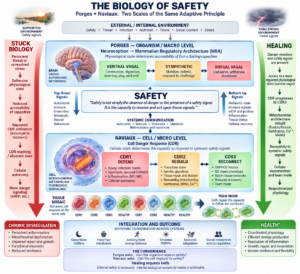
Dr. Stephen Porges studies the nervous system and developed Polyvagal Theory.
Dr. Robert Naviaux studies mitochondria—the tiny structures inside our cells that help manage energy—and developed the concept of the Cell Danger Response.
One studies the whole person.
The other studies the cell.
Yet their ideas meet in a fascinating place:
How does the body know when danger has passed?
And what happens when it doesn’t?
Your Nervous System Is Always Listening
Imagine walking through the woods and suddenly hearing something moving behind you.
Before you have time to think, your body changes.
Your heart beats faster. Your muscles tighten. Your attention sharpens. Digestion becomes less important.
Your body prepares you to move.
This is not a mistake.
It is exactly what your body is supposed to do.
Porges describes a nervous system that is constantly gathering information about the world around us and the world inside us.
Much of this happens without conscious thought.
He calls this process neuroception.
The nervous system is continually asking:
Is this person safe?
Is this environment safe?
Is something wrong inside my body?……..